
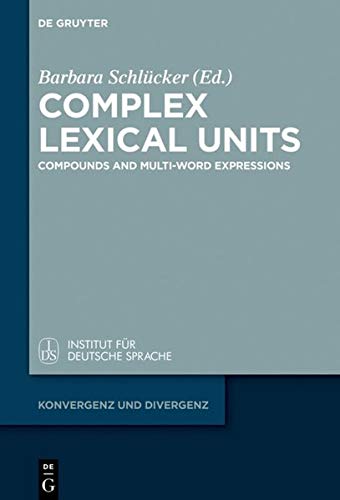
Complex Lexical Units : Compounds and Multi-Word Expressions / Barbara Schl�ucker.
Material type: TextSeries: Konvergenz und Divergenz ; 9Publisher: Berlin ; Boston : De Gruyter, [2019]Copyright date: �2019Description: 1 online resource (363 pages)Content type:
 - text
- computer
- online resource
- 3110632446
- 9783110632446
- 415 23
- P158.25
- ES 440
Frontmatter -- Inhalt -- Compounds and multi-word expressions in the languages of Europe / Finkbeiner, Rita / Schl�ucker, Barbara -- Compounds and multi-word expressions in English / Bauer, Laurie -- Compounds and multi-word expressions in German / Schl�ucker, Barbara -- Compounds and multi-word expressions in Dutch / Booij, Geert -- Compounds and multi-word expressions in French / Van Goethem, Kristel / Amiot, Dany -- Compounds and multi-word expressions in Italian / Masini, Francesca -- Compounds and multi-word expressions in Spanish / Fern�andez-Dom�inguez, Jes�us -- Compounds and multi-word expressions in Greek / Koliopoulou, Maria -- Compounds and multi-word expressions in Russian / Ohnheiser, Ingeborg -- Compounds and multi-word expressions in Polish / Cetnarowska, Bo�zena -- Compounds and multi-word expressions in Finnish / Hyv�arinen, Irma -- Compounds and multi-word expressions in Hungarian / Kiefer, Ferenc / N�emeth, Bogl�arka
Both compounds and multi-word expressions are complex lexical units, made up of at least two constituents. The most basic difference is that the former are morphological objects and the latter result from syntactic processes. However, the exact demarcation between compounds and multi-word expressions differs greatly from language to language and is often a matter of debate in and across languages. Similarly debated is whether and how these two different kinds of units complement or compete with each other. The volume presents an overview of compounds and multi-word expressions in a variety of European languages. Central questions that are discussed for each language concern the formal distinction between compounds and multi-word expressions, their formation and their status in lexicon and grammar. The volume contains chapters on German, English, Dutch, French, Italian, Spanish, Greek, Russian, Polish, Finnish, and Hungarian as well as a contrastive overview with a focus on German. It brings together insights from word-formation theory, phraseology and theory of grammar and aims to contribute to the understanding of the lexicon, both from a language-specific and cross-linguistic perspective.
In English.
Online resource; title from PDF title page (publisher's Web site, viewed 23. Jan 2019).
Open Access EbpS
There are no comments on this title.