
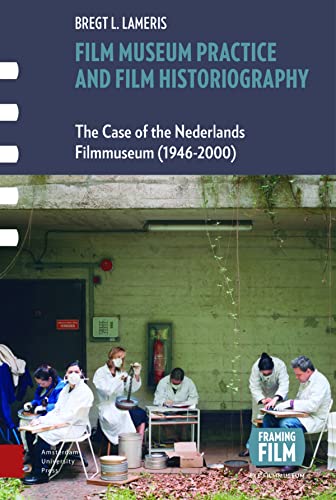
Film museum practice and film historiography : the case of the Nederlands Filmmuseum (1946-2000) / Bregt Lameris.
Material type: TextSeries: Framing film (Amsterdam, Netherlands)Publisher: Amsterdam : Amsterdam University Press, [2017]Copyright date: �2017Description: 1 online resource (270 pages) : illustrationsContent type:
 - text
- computer
- online resource
- 9789048526741
- 9048526744
- Nederlands Filmmuseum -- History
- EYE Film Instituut Nederland
- Desmet, Jean, 1875-1956
- Motion pictures -- Netherlands -- History -- 20th century
- PERFORMING ARTS -- Reference
- PERFORMING ARTS -- Film & Video -- General
- Desmet, Jean, 1875-1956
- Nederlands Filmmuseum
- Motion pictures
- Netherlands
- Nederlands Filmmuseum
- Bauhaus Dessau 1986-1994 Bereich Architektur und Sammlungen
- Filmgeschichtsschreibung
- Filmmuseum
- Diskurs
- 1900-1999
- 791 22
- PN1993.42.N48 L36 2017eb
Includes bibliographical references and index.
Rich in detail, this is a study of the interrelationships between film historical discourse and archival practices. Exploring the history of several important collections from the EYE Film Museum in Amsterdam, Bregt Lameris shows how archival films and collections always carry the historical traces of selection policies, restoration philosophies, and exhibition strategies. The result is a compelling argument that film archives can never be viewed simply as innocent or neutral sources of film history.
Online resource; title from PDF title page (EBSCO, viewed September 14, 2017).
Table of Contents; Acknowledgements; Introduction; PART I. COLLECTIONS; 1. Private Collectors; 2. Blind Choices: Parameters and Repetitions; 3. Eyes Wide Open: Duplicates; PART II. PRESERVATIONS; 4. Passive Preservation: An Historical Overview; 5. Impressions: Restoration of the Film Image; 6. Reconstructions; PART III. PRESENTATIONS; 7. Film Museum Exhibition Spaces; 8. Framing Programmes; 9. Performances; Coda: Past Futures, Future Pasts; Notes; Bibliography; Index.
Open Access EbpS
There are no comments on this title.