
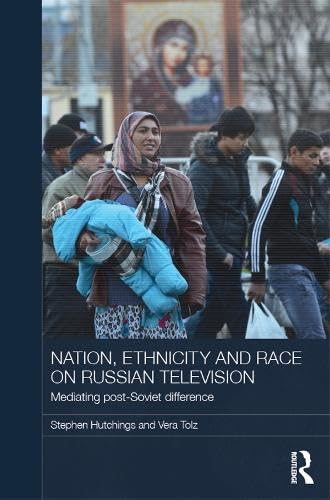
Nation, Ethnicity and Race on Russian Television : Mediating post-Soviet difference / Stephen Hutchings and Vera Tolz.
Material type: TextSeries: BASEES/Routledge series on Russian and East European studiesPublisher: London ; New York : Routledge, 2015Description: 1 online resourceContent type:
 - text
- computer
- online resource
- 9781317526247
- 1317526244
- 9781315722863
- 1315722860
- 1138853283
- 9781138853287
- Television broadcasting -- Social aspects -- Russia (Federation)
- Television and politics -- Russia (Federation)
- Race relations on television
- Ethnicity on television
- PSYCHOLOGY -- Social Psychology
- Ethnicity on television
- Race relations on television
- Television and politics
- Television broadcasting -- Social aspects
- Russia (Federation)
- 302.23/450947 23
- PN1992.3.R8
Includes bibliographical references and index.
Vendor-supplied metadata.
Cover; Title Page; Copyright Page; Table of Contents; List of figures; Acknowledgements; Note on transliteration and translation; Introduction: A clash of two Russias, a tale of two cities; 1 Television and nationhood: The broader context; PART I Managing difference; 2 Mapping an uncertain terrain: An overview of the corpus; 3 Re-inventing Russia in television news commemorations of the 'Day of National Unity': Mediation as fracture; 4 Ethnic conflict and television news coverage of the December 2010 Moscow riots: Managing the unexpected; PART II Difference at the margins.
5 Re-working Russian diversity: The 'marginal' role of television fiction6 Transcending marginality: Ethnicity, identity and religion on Vesti-Buriatiia; PART III Difference in question; 7 (Un)covering alterity: Television, the 2012 presidential elections and the ethnic underside of Russian political discourse; 8 An unholy scandal: Profanity, abjection and the production of Russian-ness in the 'punk prayer' affair; 9 'There is war on our streets ... ': The 'national question' and migration on state-aligned television after the 2012 presidential elections; Conclusion: Difference in the balance.
Russia, one of the most ethno-culturally diverse countries in the world, provides a rich case study on how globalisation and associated international trends are disrupting, and causing the radical rethinking of approaches to, inter-ethnic cohesion. The book highlights the importance of television broadcasting in shaping national discourse and the place of ethno-cultural diversity within it. It argues that television's role here has been reinforced, rather than diminished, by the rise of new media technologies. Through an analysis of a wide range of news and other television programmes, the boo.
Open Access EbpS
There are no comments on this title.